Study figure and data
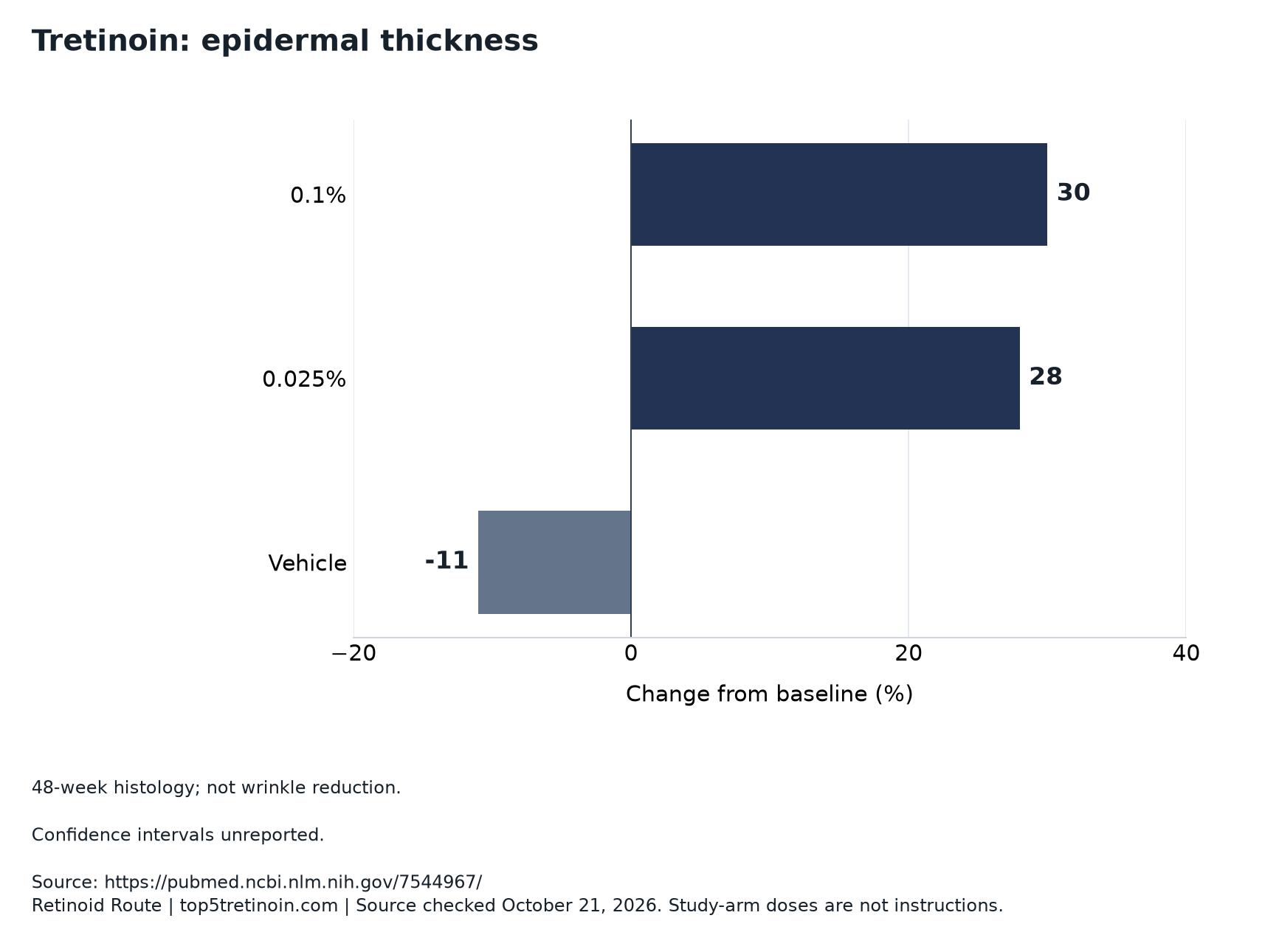
Tretinoin: epidermal thickness
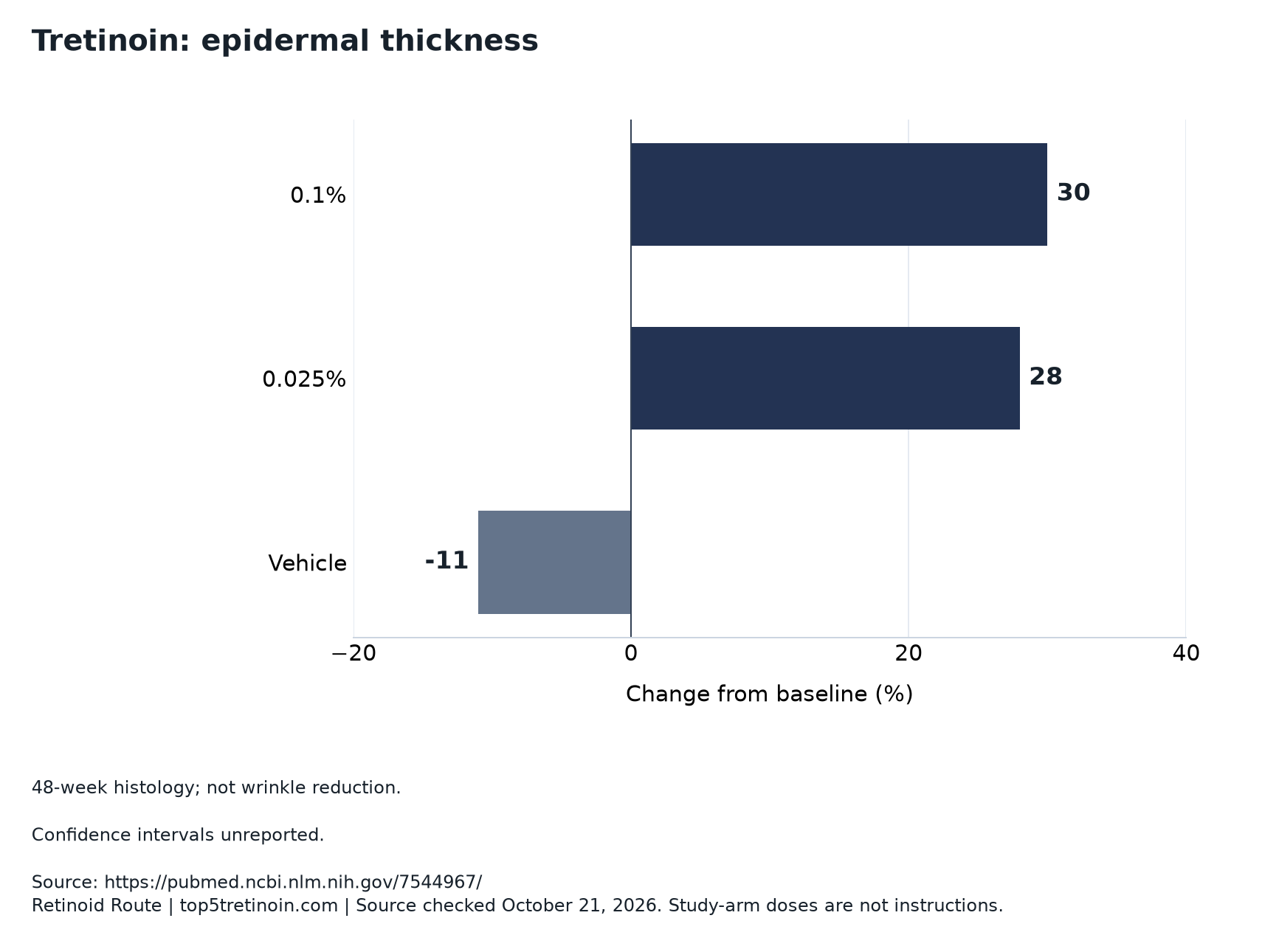
48-week histology; not wrinkle reduction.
Confidence intervals unreported.
Download chart (PNG)Download data (CSV)Download vector chart (SVG)
| Study arm | Reported value |
|---|---|
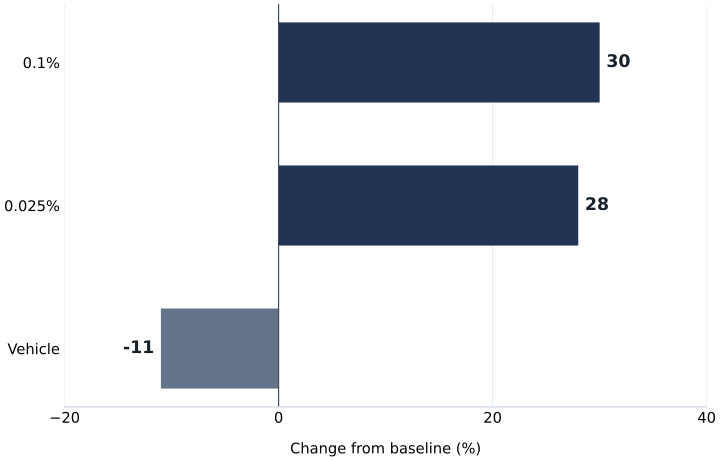
| 0.1% | 30 |
| 0.025% | 28 |
| Vehicle | -11 |
Start by naming the result and its clock
The indexed 48-week double-blind cream-comparison abstract reports 99 completers: 32 using 0.1%, 35 using 0.025%, and 32 vehicle. Facial improvement was similar between active groups; erythema and scaling were greater with 0.1%. Initial enrollment, allocation method, confidence intervals, biopsy site, funding, and an earlier clinical trajectory are unestablished in that accessible abstract. Its tissue-thickness percentages describe endpoint histology, not wrinkle reduction.
A final comparison answers a question about measurements at that point. Similar observed results do not establish equivalence, even at that endpoint. To ask which treatment acted sooner, we would need observations that distinguish earlier from later change. Filling the intervening space with a smooth line adds an assumption: it turns an endpoint into a proposed path. Several different paths could reach the same destination. Nothing about that logical possibility tells us which path occurred.
Start an evidence note with the outcome, unit, anatomical site, and assessment time. Keep the treatment identity beside them. Our guide to tretinoin, retinol, and retinal provides vocabulary for those identities. Naming them precisely helps prevent an apparently simple timeline from switching between unlike measurements or preparations midway through an explanation.
Four outcomes that require different records
A severity score describes a state. Change in that score compares two states. First response requires an additional definition: a threshold that someone had not met initially and later crosses. Sustained response adds a rule about remaining above that threshold or meeting it repeatedly. Persistence asks whether benefit is still present after treatment has ended, under specified follow-up conditions.
These distinctions matter even with perfect measurement. Someone might improve enough to cross a threshold once, move back below it, and qualify again later. Their first response remains part of their history, but it does not describe their current state. Alternatively, someone may improve steadily without crossing a demanding threshold. Calling that person a nonresponder to the threshold does not mean that every measured feature stayed unchanged.
Choose the question before choosing the summary. Otherwise a report can substitute the easiest available number for the outcome readers actually care about. A final average, the proportion ever responding, and the proportion maintaining a response each summarize something different. One is not automatically a superior version of the others.
| Question | Required definition | What the result does not establish |
|---|---|---|
| How much changed? | A specified measurement and comparison time | The first occurrence of that change |
| When was response first recorded? | A threshold, baseline status, and dated assessments | Continuous benefit after that assessment |
| Was response sustained? | A duration or repeated-assessment rule | What happened between unobserved visits |
| Did benefit persist afterward? | Post-treatment follow-up and a defined outcome | A universal duration for another individual |
An invented example with the same final total
Consider two fictional cohorts, A and B, each containing 80 people. Everyone starts without a predefined qualifying response, and everyone remains observed through the final assessment. By an early assessment, 32 people in A and eight in B have first qualified. By the final assessment, 64 in each cohort have qualified at least once. These are invented cumulative first-recorded responses, not data from a retinoid trial.
The early totals differ by 24 people, or 30 percentage points: 40% versus 10%. The final cumulative totals are both 80%. That combination is logically possible without any contradiction. Equality in the final cumulative count does not erase an earlier difference in first recorded response. Conversely, the early difference does not establish a difference in final cumulative response.
The table says nothing about how many people currently qualify at the final visit. Some could have lost the response after first qualifying. It also says nothing about uninterrupted benefit. A cumulative first-event count cannot go backward, even when an individual outcome later worsens. The companion guide to planned and received treatment examines another record that must stay separate from an outcome timeline: actual exposure.
| Assessment | Invented cohort A | Invented cohort B |
|---|---|---|
| Early assessment | 32 of 80 have qualified at least once | 8 of 80 have qualified at least once |
| Final assessment | 64 of 80 have qualified at least once | 64 of 80 have qualified at least once |
| Currently responding at the final visit | Not specified by these cumulative counts | Not specified by these cumulative counts |
| Maintained response continuously | Not specified by these cumulative counts | Not specified by these cumulative counts |
Visits bracket an observation, not every moment
Suppose a fictional participant does not meet the threshold at one visit and meets it at the next. If their response had been continuously absent before the earlier visit, those observations would place a qualifying occurrence somewhere afterward. They would still not identify its exact moment. A visit date is the date of observation; it need not be the date the change began.
There is a further complication when outcomes can fluctuate. A brief earlier response might occur and disappear between visits. In that situation, the first recorded response could follow the first true occurrence by an unknown interval. Assuming that the outcome only improves would conceal this possibility. Researchers need to state whether they are estimating first detection, first occurrence under a model, or repeated qualification.
More frequent assessments can narrow gaps, but a different schedule also creates different opportunities to detect transient changes. A comparison between studies with unequal visit spacing therefore needs more than matching calendar labels. Photographs taken under consistent conditions, prespecified assessment rules, and transparent dates help readers understand what was actually observed. They cannot reveal an unrecorded episode merely by being presented in chronological order.
Statistical detection is not a biological starting signal
Statistical significance describes how the observed data relate to a specified statistical model and hypothesis. It does not mark the instant when a treatment started acting. An estimated difference could exist at an earlier assessment yet remain too imprecise to distinguish clearly from zero. A later result could become more precise without representing the first meaningful change for any particular participant.
Precision depends on features such as sample size, variability, and the analysis. Visit frequency determines how often detection is attempted. If investigators repeatedly examine many outcomes and dates, they also need an appropriate plan for interpreting those multiple opportunities. Selecting the first favorable date afterward can make an apparent starting point look more definitive than the analysis supports.
Clinical importance is another judgment. A narrowly estimated difference can be small, while an important possible difference can remain uncertain. A useful report identifies the size of the change and its uncertainty, then explains how a meaningful response was defined. Our guide to irritation questions for a prescriber can help frame a separate discussion of symptoms; statistical detection should not become an instruction to tolerate symptoms until a particular date.
Completeness of follow-up shapes the timeline
The randomized paired retinol study followed protected upper-inner-arm sites for 24 weeks in 36 people averaging 87 years: 23 completed and 13 withdrew, three for irritation/pruritus. Laboratory 0.4% lotion averaged 1.6 weekly applications versus up to three planned. Its primary outcome analysis carried observations forward within intention-to-treat analysis; only significant biopsy effects were reported. Four inventors disclosed conditional royalty interests.
This example introduces a general distinction between an analysis population and an observed visit population. An analysis may retain people through a rule for unavailable measurements. That does not mean every value was observed at its assigned analysis time. Carrying an earlier value forward is an assumption used to complete a dataset, not a new examination of the participant.
For a timeline, ask which people were actually assessed at each visit and what happened to those no longer observed. A chart restricted to completers can answer a different question from an analysis retaining the original cohort. Neither label alone establishes what missing participants experienced. Transparent reporting should show the counts, reasons for missingness, and sensitivity of conclusions to reasonable alternative assumptions.
A longer study is not a continuation of another study
The 2005 randomized emollient-cream report describes 204 people treated with 0.05% tretinoin or vehicle for up to two years. Its abstract reports greater facial improvement without usable effect magnitudes or allocation/completion counts. The accessible acknowledgment documents OrthoNeutrogena support and employment, equity, research, and consulting relationships; complete methods and results were not reviewed.
A longer observation window can address questions that a shorter one cannot reach. But placing studies end to end does not create a single longitudinal cohort. Different participants, measurements, interventions, and eligibility rules can change what a result means. Even an apparently matching outcome name may hide differences in scoring or assessment conditions. A genuine comparison needs those definitions examined, rather than a timeline assembled from study durations.
Our guide to considering tretinoin with drier skin offers context for discussing individual circumstances. Scientifically, the next step is to ask whether the target population and outcome resemble those under study. A funding disclosure helps identify relationships relevant to interpretation; it does not resolve a missing time course or automatically invalidate an observed result. Those questions require different evidence.
Persistence needs a new starting point for follow-up
For persistence, time zero may be the end of treatment rather than the beginning. That choice changes the question. Researchers would need to define who enters follow-up, whether entry depends on prior response, what subsequent treatment is allowed, and how a retained benefit is measured. Following only initial responders describes that selected group, not every person who began treatment.
Current RENOVA labeling concerns tretinoin cream 0.02% for adjunctive mitigation of fine facial wrinkles alongside comprehensive skin care and sun avoidance. Safety and efficacy beyond 52 weeks, and in people older than 71, are not established for that product. Those boundaries are formulation-specific; they are not supplied by a different preparation’s research.
That separation matters when reading a long-term claim. During-treatment observation, after-treatment persistence, and the scope of a product label are not interchangeable timelines. The guide to approved and compounded products helps organize questions about formulation identity. For research interpretation, retain the actual treatment boundary and follow-up conditions. An observed difference after treatment ends would still require its magnitude, uncertainty, and participant accounting before supporting a claim about durability.
Design a fair test of faster improvement
A future speed comparison should begin with a common outcome and a prespecified threshold for meaningful response. Contemporaneous groups would need aligned assessment schedules and comparable measurement conditions. The analysis should distinguish first observed response from sustained response, show participant counts at each assessment, and explain how interruptions and unavailable observations are handled. Random assignment can support a causal comparison, but it does not repair a poorly defined outcome.
The study should also state which question matters most before results are known. An early advantage, a final difference, and a longer duration of benefit could each matter, yet they need not favor the same intervention. A measure summarizing benefit over time would require explicit weighting and assumptions between visits. It should not be presented as a universal score of treatment value.
Access arrangements belong in a separate documentary comparison. Our Miiskin consultation review and Dermatica formula review invite checking published service terms. These links do not connect either provider to the study preparations or outcomes. Availability of follow-up can be discussed as a service question without implying that a provider has demonstrated faster improvement.
Turn the evidence into questions about expectations
A useful clinical conversation starts with the outcome that matters to the person, rather than a study deadline. Ask how improvement will be recognized, which features will be documented, and what kind of variation would make two observations difficult to compare. Ask what follow-up is intended to assess and which symptoms need contact with the clinician. These questions seek an individualized plan without supplying one here.
It can help to bring a short evidence note with separate fields for the treatment, outcome, assessment window, and uncertainty. Leave onset blank when it is not established for the relevant question. Leave persistence separate from the final during-treatment result. This avoids turning an impressive endpoint into a promise about every week leading to it or every month afterward.
Our online consultation guide offers a place to organize practical questions before that conversation. The scientific goal is a shared definition of what is being evaluated. Once that definition is clear, a clinician can explain which evidence is relevant and how individual circumstances affect follow-up. A research timetable alone cannot make that judgment.
Questions about the evidence
Does a final assessment tell me when everyone first improved?
No. A final measurement describes an outcome at that assessment. First response needs a definition and earlier observations that can locate its occurrence or detection. Even a complete set of final scores would not reconstruct the dates on which participants first crossed a threshold. That requires a different record.
If two groups end with similar results, could their earlier experiences differ?
Yes, as a logical possibility. The fictional cohorts illustrate how cumulative first-response totals can match at the end while differing earlier. That example does not establish such a pattern in a real trial. To determine an actual pattern, inspect the observed sequence, participant counts, and uncertainty.
Why is a cumulative response count different from a current response count?
A cumulative count retains everyone who has qualified at least once. A current count asks who qualifies now. Someone can remain in the cumulative total after losing the response. Neither count, by itself, tells how long each person benefited or whether improvement remained continuous between visits.
Can I compare speed using results from studies with different durations?
Duration alone is insufficient. A fair comparison needs compatible populations, interventions, outcomes, assessment schedules, and analyses. Otherwise an earlier reported result could reflect a different question or an earlier opportunity to measure it. Combining separate study endpoints does not create observations from one common timeline.
What should I ask about a claim of lasting benefit?
Ask when follow-up began, who remained observable, how benefit was defined, and what treatments were used afterward. Also ask whether the result concerns all starters or only earlier responders. These details identify the population and conditions behind the claim; they do not set a personal stopping or restarting schedule.
Editorial assessment
The strength of a timeline claim depends on the record needed to answer it. Endpoint change, first recorded response, repeated response, and persistence are separate quantities. Read them with their own definitions and denominators. A well-supported final comparison can remain useful even when onset is unresolved. An informative early observation can remain useful without proving durable benefit. Keeping those questions separate makes the evidence more precise and helps a clinical conversation focus on the uncertainty that actually matters.
Research access and limitations
Evidence access varies: an indexed concentration-study abstract; the complete retinol article; a long-term-study abstract with publisher disclosures; and current official labeling. No individual-level data were examined. The cohort example and reading frameworks are original illustrations. They estimate no treatment effect or individual timetable.